For many students, the idea of preparing for Government Exams can feel difficult, especially when they believe that only academically strong students can secure a government job. In reality, competitive exams are not based only on school or college marks. With the right exam choice, consistent practice, basic concepts, and a practical study routine, average students can also perform well. Many government recruitment exams have manageable syllabi and focus mainly on mathematics, reasoning, English, general awareness, and basic computer skills. For students in Ajmer and nearby areas, choosing the right examination is an important first step. Instead of preparing for every competitive exam at the same time, students should select an exam according to their qualification, interests, preparation time, and preferred type of government job. Exams such as SSC MTS, Railway Group D, SSC CHSL, and banking clerk examinations can be suitable choices depending on educational qualification. Students who want to enter the teaching field can also consider eligibility-based examinations such as CTET. The most important thing to remember is that being an “average student” does not mean being incapable of clearing Government Exams. A student who studies regularly for three to six months, understands the exam pattern, solves previous-year papers, takes mock tests, and learns from mistakes can make significant progress. The key is not studying everything; it is studying the right things consistently.
Which Government Exams Are Suitable for Average Students?
There are several Government Exams that students can consider after Class 10, Class 12, or graduation. The best option depends on the candidate’s qualification and the type of work they want to pursue. Entry-level examinations generally focus on basic aptitude, reasoning, language skills, general knowledge, and subject fundamentals rather than extremely advanced concepts. SSC MTS is one option for candidates who have completed Class 10. The examination covers areas such as numerical ability, reasoning, English language, and general awareness. Since the qualification requirement is relatively accessible and the syllabus is based largely on fundamental concepts, students who build a strong foundation can prepare effectively. It can be a useful option for candidates looking for staff-level government employment through the Staff Selection Commission. Railway Group D is another popular option among candidates who have completed Class 10 or hold an ITI qualification, subject to the applicable recruitment notification. Railway recruitment attracts candidates from different educational backgrounds because of the large number of applicants and the wide range of railway jobs. Preparation generally includes mathematics, reasoning, general science, and general awareness, along with the physical requirements applicable to the recruitment process. For students who have completed Class 12, SSC CHSL can be an important examination to consider. It recruits candidates for various posts depending on the notification and eligibility requirements. The preparation generally involves quantitative aptitude, English, general intelligence, and general awareness. Students who are comfortable with basic arithmetic and language questions can gradually improve their performance through regular practice. Graduates can explore IBPS and SBI Clerk examinations if they are interested in banking jobs. These examinations generally test reasoning ability, quantitative aptitude, English language skills, and other areas according to the applicable recruitment pattern. Banking examinations can appear challenging at first because of time pressure, but students can improve considerably by practising questions regularly and developing calculation speed. Students interested in teaching can consider CTET, provided they meet the prescribed educational and professional qualifications for the relevant paper. CTET preparation focuses on areas such as child development and pedagogy, language, and the relevant subject areas. Candidates should always check the latest official notification and eligibility conditions before selecting an examination. Rather than asking which exam is the easiest, students should ask which Government Exam matches their qualification and strengths. An examination that suits your educational background and interests will usually be easier to prepare for than an examination selected only because someone else considers it easy.
How Can an Average Student Prepare for Government Exams?
The biggest advantage for an average student is that competitive-exam preparation can be improved through practice. A student may initially score poorly in mathematics or reasoning, but regular question-solving can improve both accuracy and confidence. The first goal should be to understand the fundamentals instead of immediately attempting difficult questions. A preparation period of around three to six months can provide a useful framework for many entry-level and clerical competitive examinations, although the actual time required depends on the exam, current preparation level, available study hours, and recruitment schedule. Students who are starting from the basics should spend the early part of their preparation strengthening fundamental concepts before moving toward speed-based practice. Begin by understanding the complete syllabus and examination pattern. Make a simple list of subjects and divide them into manageable areas. For example, mathematics can be divided into percentages, profit and loss, averages, ratio and proportion, time and work, simple interest, data interpretation, and other relevant topics. Reasoning can similarly be divided into coding-decoding, series, analogy, classification, syllogism, blood relations, direction questions, and other commonly tested areas. Study material should also be limited. Collecting too many books does not automatically improve preparation. Choose reliable books and practice resources that explain concepts clearly. Standard resources such as R.S. Aggarwal for quantitative aptitude and reasoning and a dependable general knowledge resource such as Lucent GK can be useful for building fundamentals. For English, students can use a basic grammar and vocabulary resource along with regular reading practice. Previous-year question papers should become an important part of the preparation routine. They help students understand what the examination actually asks instead of allowing them to spend too much time on unnecessary topics. While solving previous papers, note repeated concepts, common question formats, frequently tested topics, and areas where mistakes occur. This makes preparation more focused and can be especially helpful for students who have limited study time. Mock tests are equally important because knowing the answer is not enough in a competitive examination. Candidates often lose marks because they spend too much time on one question, make calculation errors, misunderstand instructions, or become nervous under time pressure. Regular timed mock tests help develop speed, accuracy, question selection, and exam temperament. One simple method is to maintain an error notebook. Whenever you make a mistake in a mock test or practice paper, write down the question type, the reason for the mistake, and the correct method. Review these mistakes regularly. If the same type of error appears repeatedly, give that topic additional practice rather than simply moving on to a new chapter. General awareness should also be studied consistently rather than left entirely for the final weeks. Depending on the examination, candidates may need to prepare areas such as Indian history, geography, polity, economics, science, current affairs, and general knowledge. Short daily revision sessions can be more effective than trying to memorize a large amount of information in one sitting.

Simple Study Strategy for Government Exams
A practical study routine is often more useful than studying for extremely long hours for a few days and then taking several days off. Average students should concentrate on consistency, revision, practice, and accuracy. Even a few focused hours every day can produce meaningful improvement when the study plan is followed regularly. A simple daily routine can include mathematics, reasoning, English, and general awareness, with time divided according to personal strengths and weaknesses. Students who are weak in mathematics should not avoid it. Instead, they should start with basic calculations and gradually move toward examination-level questions. Similarly, students who struggle with English can work on grammar, vocabulary, reading comprehension, and error correction through regular practice. The first month should primarily focus on fundamentals. Learn basic formulas, concepts, grammar rules, reasoning patterns, and important general knowledge areas. Do not worry too much about speed during this stage. Accuracy and conceptual understanding should come first. During the second month, increase the amount of question practice. Start solving topic-wise previous-year questions and short timed tests. This is also the stage where students should identify their strongest and weakest subjects. Spending equal time on every topic is not always necessary; weaker areas may require additional practice. In the following months, gradually introduce full-length mock tests. After every test, spend time analysing the result. Simply checking the score is not enough. Find out which questions were incorrect, which questions consumed too much time, and which questions were left unanswered. The analysis is often more valuable than taking the test itself. Revision should continue throughout the preparation period. Make short notes for formulas, important facts, vocabulary, confusing concepts, and frequently repeated questions. These notes can become valuable during the final revision period. Students preparing in Ajmer can also benefit from joining a structured learning environment if they find self-study difficult. A coaching or study-support environment can provide a fixed routine, guidance, practice tests, doubt-solving support, and interaction with other aspirants. For students who struggle with maintaining consistency at home, this type of structured preparation can make the process easier.
Common Mistakes Students Should Avoid
One of the most common mistakes is trying to prepare for too many Government Exams simultaneously. Although SSC, Railway, banking, and other competitive examinations may share several subjects, their patterns, difficulty levels, and selection processes can differ. Select one primary target and keep closely related examinations as secondary options. Another mistake is changing study material repeatedly. Students sometimes move from one book, YouTube channel, or preparation source to another whenever they find a topic difficult. This can create confusion and waste valuable preparation time. Choose dependable resources and complete them systematically. Ignoring previous-year papers is another major problem. Competitive examinations follow patterns, and previous papers provide direct insight into those patterns. Students should solve them regularly and use them to identify important topics. Do not spend the entire preparation period only studying theory. Competitive exams require application, speed, and accuracy. Once a concept is understood, solve questions based on it. Gradually introduce timed practice and full-length mock tests. Finally, avoid comparing your preparation with other candidates. Some students may already have strong fundamentals, while others may be starting from the beginning. Your progress should be measured by your own scores, accuracy, speed, and consistency. An average student can become a strong candidate through disciplined preparation.
Government Exam Preparation in Ajmer
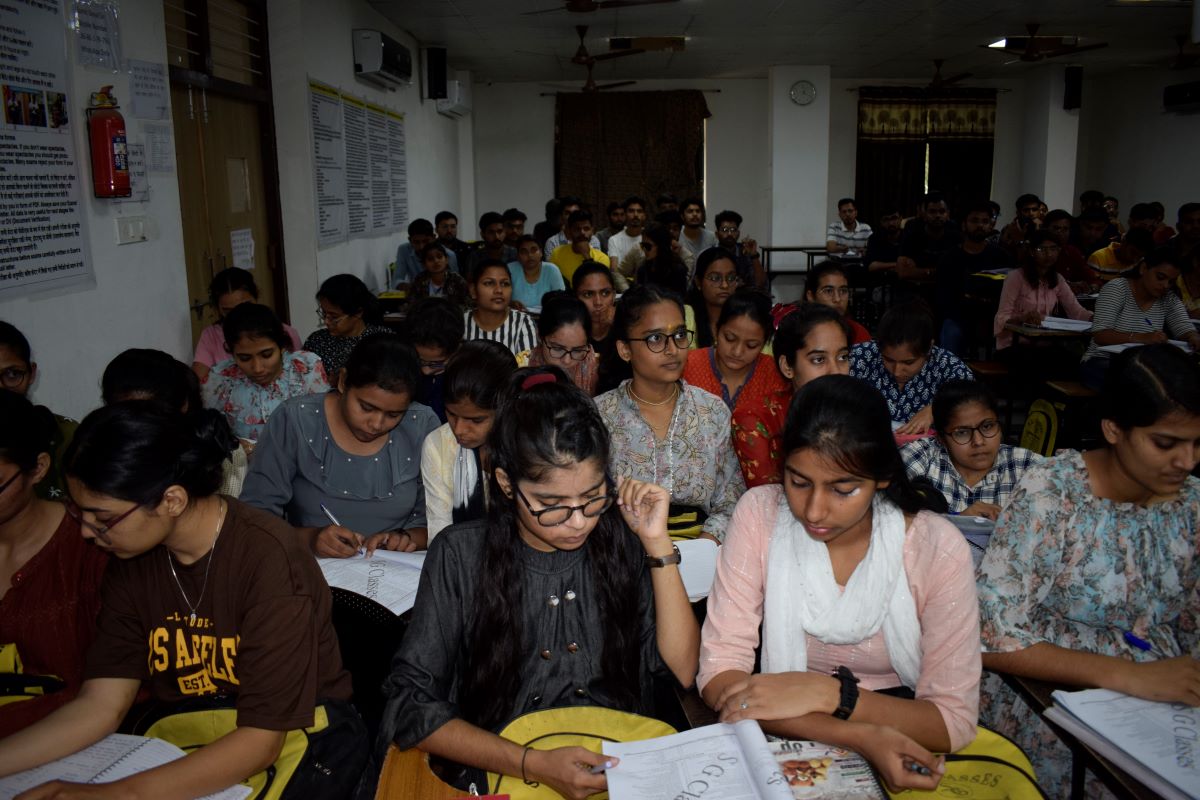
For students searching for Government Exam preparation in Ajmer, the first step is to identify the examination that matches their qualification. Class 10 students can explore suitable staff and railway opportunities, Class 12 students can consider examinations such as SSC CHSL and other eligible recruitment exams, while graduates can explore banking, SSC, and other graduate-level opportunities. Eligibility and selection processes can change, so candidates should always verify the latest official notification before applying. SG Classes can help students approach competitive-exam preparation with a structured and practical study routine. Instead of focusing only on completing books, students should work toward understanding concepts, practising examination-level questions, improving speed, revising regularly, and analysing mock-test performance. For an average student, the objective should not be to become perfect in every subject immediately. The better approach is to improve step by step. If mathematics is weak, strengthen basic arithmetic first. If reasoning is difficult, practise one question type at a time. If general awareness is weak, create a daily revision habit. Small improvements across different subjects can eventually make a significant difference in the overall score. The journey toward a government job requires patience because competition can be high and selection depends on performance. However, a weak score in the beginning does not determine the final result. With a realistic target, suitable study material, previous-year papers, mock tests, regular revision, and consistent effort, students can significantly improve their chances of clearing competitive examinations.
Conclusion
Choosing the right Government Exam is more important than simply choosing the exam that appears easiest. Students should consider their qualification, interests, strengths, preparation time, and preferred career path before making a decision. SSC MTS and Railway Group D can be considered by eligible Class 10 candidates, SSC CHSL by eligible Class 12 candidates, banking clerk examinations by graduates, and CTET by candidates who meet the required teaching qualifications. Average academic performance should never become a reason to stop preparing. Competitive examinations reward preparation, accuracy, speed, and consistency. A student who starts with basic concepts and gradually develops stronger problem-solving skills can compete effectively with candidates who may have performed better academically. For students in Ajmer, a structured preparation plan can make the process more manageable. Set one clear target, understand the syllabus, study the basics, solve previous-year papers, take mock tests, analyse mistakes, and revise regularly. With disciplined preparation and the right guidance, Government Exams can become a realistic career pathway for average students as well.
FAQs
Have questions? We’ve answered some of the most common queries to help you understand the topic better
Q1. Can an average student crack Government Exams?
Yes. With consistent study, practice, revision, and mock-test analysis, average students can prepare successfully for suitable Government Exams.
Q2. Which Government Exam is suitable after Class 10?
Eligible candidates can consider examinations such as SSC MTS and Railway Group D, depending on the latest recruitment notification.
Q3. Which Government Exam is suitable after Class 12?
SSC CHSL is one important option for eligible Class 12 candidates, along with other examinations matching their qualification.
Q4. How many months are needed to prepare?
A focused 3–6 month preparation plan can be useful for many entry-level examinations, depending on the student’s starting level and the specific exam.
Q5. Is coaching necessary for Government Exams?
Coaching is not compulsory, but structured guidance can help students maintain consistency, understand difficult topics, practise regularly, and analyse their performance.
Post a comment Cancel reply
Related Posts
Best Government Exams After B.Com in Ajmer
After completing B.Com, many students start looking for a stable career with good growth and…
IBPS PO Exam 2026 Complete Guide
The IBPS PO Exam 2026 is one of India’s most sought-after competitive examinations for candidates…
Ajmer Best Government Exam Coaching Center
In today’s competitive world, government jobs remain one of the most secure and respected career…
Government Job Coaching in Ajmer
Government jobs continue to be one of the most reliable and respected career options in…